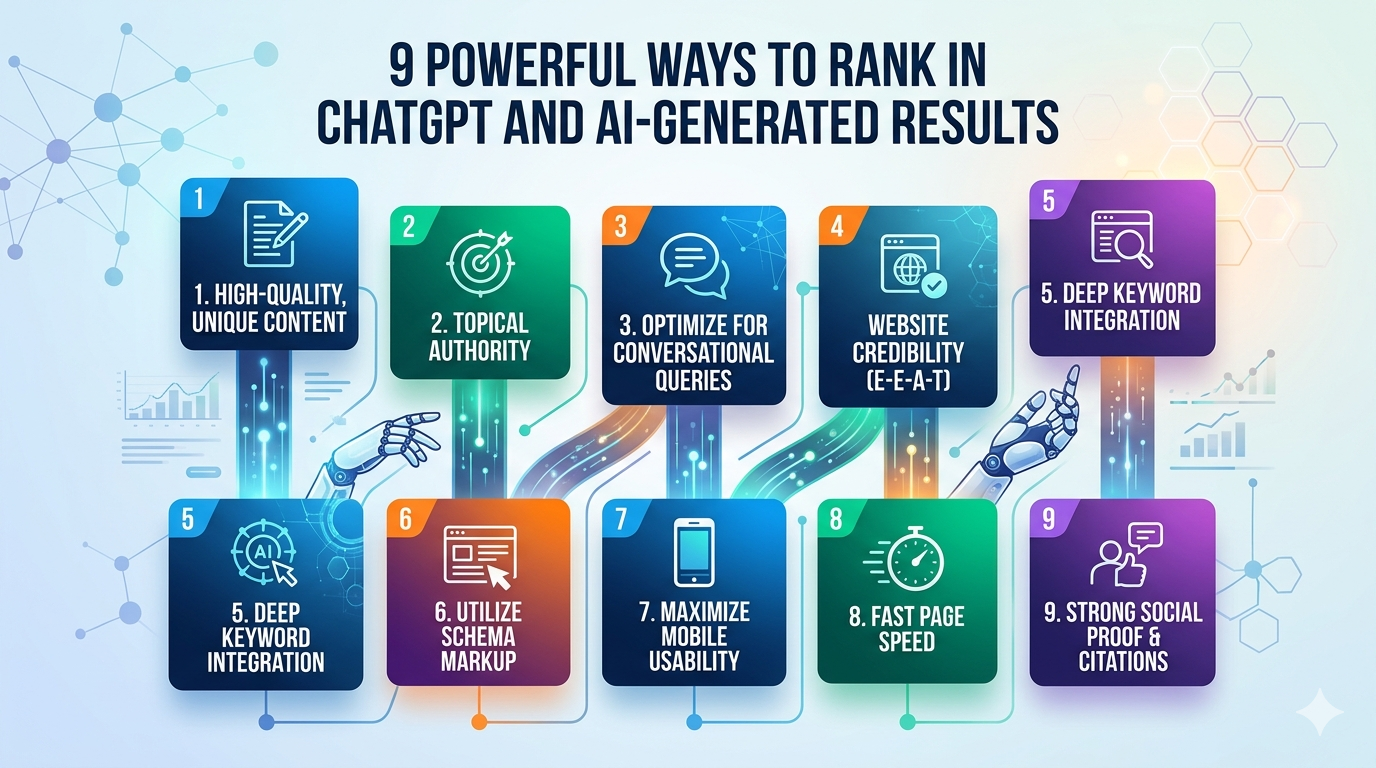
The rules of visibility have changed. Millions of people are now turning to ChatGPT, Google’s AI Overviews, Perplexity, and Microsoft Copilot for answers and these AI systems do not simply crawl your page and show a link. They synthesise, summarise, and cite. If your brand is not in that synthesis, you are invisible to a rapidly growing segment of your audience.
Traditional SEO still matters. But a new discipline is emerging alongside it: optimising for AI-generated results. This guide breaks down 9 actionable strategies to get your brand cited, referenced, and recommended by large language models (LLMs) in 2026 and beyond.
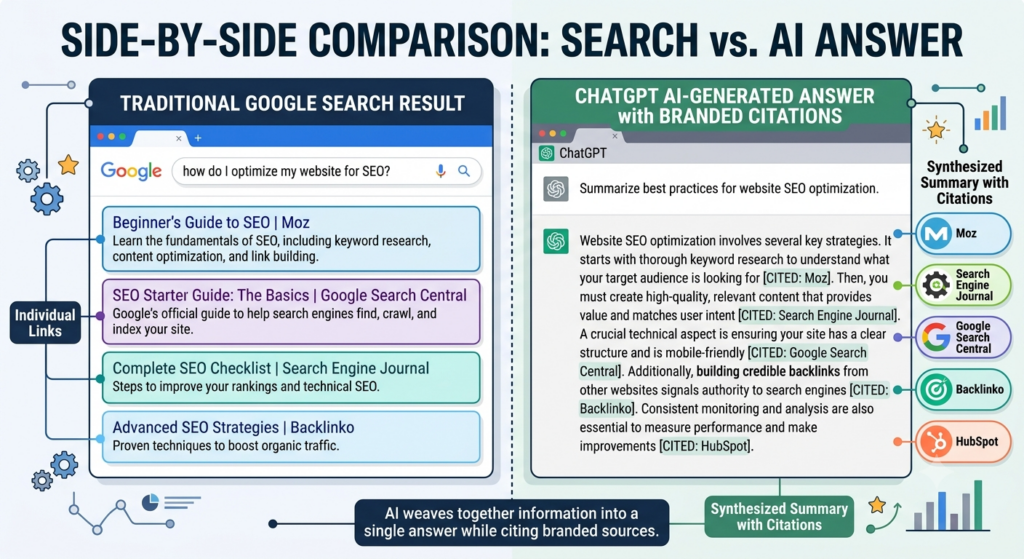
Why Brand Mentions Now Drive Visibility
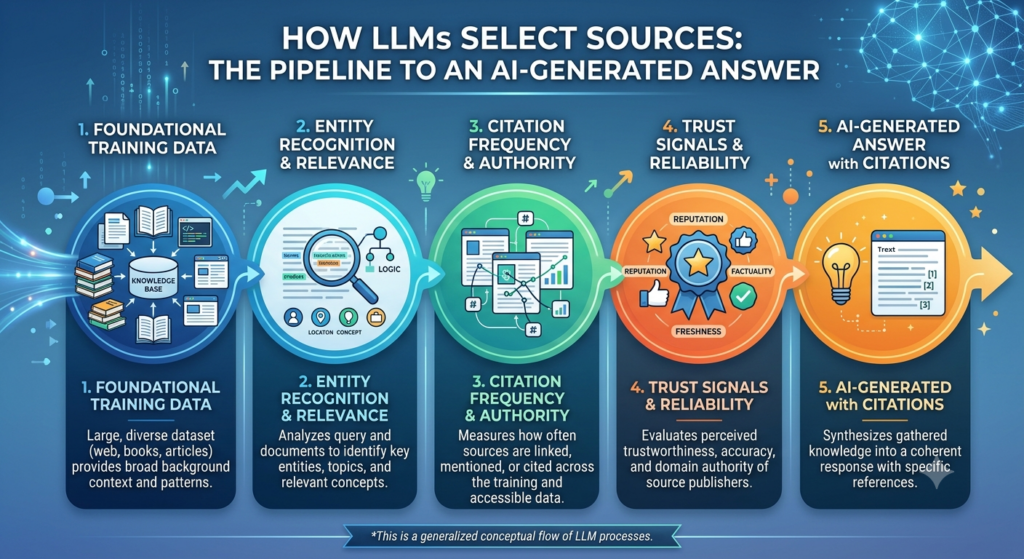
LLMs like ChatGPT are trained on vast datasets scraped from across the web. When generating answers, they weight sources they have encountered frequently, consistently, and authoritatively. According to research from Brandwatch, brands with higher mention frequency across independent, credible sources are significantly more likely to be surfaced in AI-generated responses.
In short: AI does not just follow links. It follows reputation. The more your brand name is associated with a topic across trusted, independent sources, the more likely an LLM is to cite you when a user asks about that topic.
“AI models are not ranking websites — they are ranking entities. Your brand must exist as a trustworthy, well-documented entity across the web.” — Search Engine Journal, 2025
1. Build Entity-Level Authority
Google’s Knowledge Graph and LLMs both operate on the concept of entities named, real-world things (brands, people, places, concepts) with defined attributes. To rank in AI results, your brand must exist as a recognised entity. Start with a complete and verified Google Business Profile, a Wikipedia or Wikidata entry if eligible, and consistent structured data (schema markup) across your website.
• Use Organisation schema with your full legal name, logo, social profiles, and founding date.
• Create and maintain a consistent brand presence across LinkedIn, Crunchbase, and industry databases.
• Ensure your about page clearly defines who you are, what you do, and who you serve — in plain, crawlable language.
2. Increase Brand Mentions Across Independent Sites
LLMs give greater weight to brands that appear across many different, independent sources rather than just their own website. One mention on Forbes carries more signal than twenty mentions on your own blog.
Pursue guest contributions, expert quotes, and press coverage on authoritative publications in your industry. Tools like HARO (Help a Reporter Out) and Qwoted connect brands with journalists actively seeking expert commentary — a direct path to high-authority, independent mentions.
• Aim for unlinked brand mentions as well as linked ones AI models process both.
• Monitor your mentions using tools like Google Alerts or Mention.com and engage actively.
3. Build a Strong Local SEO Presence
For businesses serving specific geographies, local signals matter even in AI search. BrightLocal’s Local Consumer Review Survey confirms that 98% of consumers read online reviews for local businesses — and AI tools pull from the same local data sources to recommend businesses in geo-specific queries.
• Keep your NAP (Name, Address, Phone) perfectly consistent across every online directory.
• Actively collect and respond to Google reviews response rate is a trust signal.
• Add LocalBusiness schema to every relevant page of your website.
4. Optimise Your Presence on Major Review Platforms
ChatGPT and other LLMs are trained on review platforms including Trustpilot, G2, Clutch, and Google Reviews. A strong, recent review presence on these platforms increases the likelihood that AI will recognise your brand as a trusted option when users ask for recommendations.
• Set up a systematic process for requesting reviews post-purchase or post-project.
• Respond professionally to all reviews, positive and negative alike.
• Maintain updated, accurate profiles with service descriptions and category tags.
5. Leverage Niche Directories and Industry Platforms
General directories matter, but niche ones matter more for topical relevance. Being listed on the most authoritative platforms in your specific industry tells AI models that you are a legitimate player in that space not just a generic business.
For example, a marketing agency should be listed on Clutch and DesignRush. A SaaS product should appear on G2 and Capterra. Identify the top three to five directories in your vertical and ensure your profile is complete, keyword-rich, and regularly updated.
6. Publish Answer-First Content
LLMs extract answers from content that is clearly structured around a question and answer. If your page buries the key insight three paragraphs down, AI will skip it. The solution is answer-first writing: lead every section with a direct, concise response to the implied question, then expand with supporting detail.
• Place the direct answer in the first one to two sentences of each section.
• Use H2 and H3 headings phrased as questions where natural — these match conversational queries.
• Keep paragraph length short — three to four sentences maximum — for easier AI extraction.
According to Semrush’s content study on AI snippets, pages that lead with a direct answer to the target query are 2.1× more likely to be cited in AI Overviews than pages with the same keyword but buried answers.
7. Structure Content for AI Extraction
Beyond answer-first writing, the technical structure of your content determines how well AI can parse and cite it. Implement the following across all key pages and blog posts:
• FAQ schema: mark up your most common questions with FAQPage structured data.
• HowTo schema: for any step-by-step guides or process-based content.
• Article schema: include author name, publish date, and last-modified date on every blog post.
• Table of contents: helps AI understand page structure and find specific sections.
Use Google’s Rich Results Test to verify your schema is implemented correctly and eligible for enhanced visibility in both traditional and AI-driven search results.
8. Build Topical Authority with Content Clusters
A single well-written article will not make you an authority. LLMs like Google before them reward sources that cover a topic comprehensively across many interlinked pages. This is the content cluster model, popularised by HubSpot’s pillar page strategy, and it is even more important in the age of AI.
Build a pillar page for each core topic in your industry, then create supporting cluster content that addresses every related subtopic and question. Interlink them explicitly. The more comprehensively you cover a topic cluster, the more confidently an LLM will cite you as an authority on it.
Earn Citations Through Digital PR and Partnerships
Digital PR is the most powerful lever for earning the kind of independent, authoritative mentions that AI models trust. Place original research, data studies, and expert commentary in publications like Forbes, Search Engine Journal, and HubSpot Blog to build citations that carry lasting training-data weight.
Strategic partnerships with complementary brands can also generate co-authored content, joint studies, and mutual mentions across each other’s audiences multiplying your entity footprint without paid media spend.
Frequently Asked Questions
How long does it take to rank in ChatGPT results?
There is no fixed timeline. Unlike Google, which re-crawls pages regularly, LLMs are retrained periodically. Building entity authority, earning independent mentions, and publishing structured content will improve your chances over time, but results depend on retraining cycles and how competitive your niche is.
Does Google SEO still matter if AI search is growing?
Yes — absolutely. The same authority signals (backlinks, E-E-A-T, structured content, technical health) that improve your Google rankings also improve your AI visibility. SEO and LLM SEO are complementary, not competing strategies.
Can small businesses rank in AI-generated results?
Yes. Local SEO, niche directory presence, and review platform optimisation are highly accessible strategies for small businesses and often yield faster results than competing with large brands on broad queries.
Drive AI Visibility with a Strategic SEO Approach
The nine strategies in this guide are not isolated tactics — they work as a system. Entity authority amplifies your content signals. Independent mentions reinforce your topical credibility. Structured content makes both easier for AI to extract and cite.
Start with the foundations: claim and complete every profile, implement schema markup, and audit your existing content for answer-first structure. Then build outward — earning mentions, building clusters, and executing digital PR. AI visibility compounds over time, just like traditional SEO.
Why AI Visibility Must Be Part of Your SEO Strategy
The share of searches answered directly by AI without a click is growing rapidly. SparkToro research already shows that well under 60% of Google searches result in a click. As AI Overviews and answer engines expand, that number will continue to fall.
Brands that treat AI visibility as optional are ceding ground to competitors who understand that the search landscape of 2030 will be dominated by entities, not just pages. The time to build your AI presence is before everyone else does.
Want to build an AI visibility strategy for your brand? Explore Eximo Digital’s LLM SEO & AI Visibility Services built for the next decade of search.