For small businesses, local search has always been the highest-stakes game in digital marketing. A customer searching for a plumber, a café, or a dental clinic nearby is ready to act and whoever appears first wins the business. In 2026, that game has a new dimension: Answer Engine Optimization (AEO).
AI-powered tools, Google’s AI Overviews, ChatGPT, Perplexity, and Apple’s Siri are now answering local queries directly, recommending specific businesses, reading out reviews, and summarizing directions without a single click. If your small business is not optimized for these AI-generated local answers, you are handing customers to competitors who are.
This guide covers the most effective local AEO best practices small businesses can implement right now no enterprise budget required.
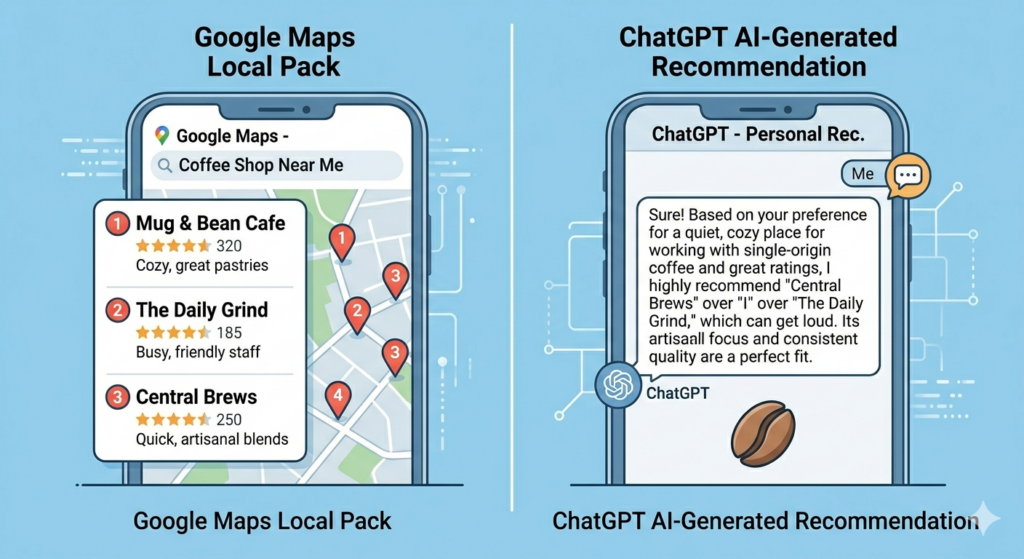
What Is Local AEO and Why Does It Matter for Small Businesses?
Answer Engine Optimisation (AEO) is the practice of structuring your online presence so that AI-powered answer engines can find, understand, and recommend your business in response to user queries. Local AEO applies this specifically to geo-targeted searches queries like ‘best coffee shop near me,’ ’emergency electrician in [city],’ or ‘highly rated physio in [suburb].’
According to BrightLocal’s 2025 Local Consumer Review Survey, 87% of consumers used Google to evaluate local businesses in the past year and AI Overviews now appear in a significant share of those local searches. For small businesses, being present in those AI results is the new front page.
“By 2026, AI answer engines have become the first point of contact between local consumers and local businesses. Local AEO is no longer optional it is table stakes.” Search Engine Land, 2025
1. Fully Optimise Your Google Business Profile
Your Google Business Profile (GBP) is the single most important local AEO asset you have. AI Overviews, Google Maps, and voice assistants all draw directly from GBP data to answer local queries. An incomplete or outdated profile is an invisible profile.
Treat your GBP as a living document, not a one-time setup. Every field matters:
- Business name, address, and phone number exactly matching every other online source.
- Primary and secondary business categories be as specific as possible.
- Business description write in natural language, include your core services and location.
- Opening hours, holiday hours, and service areas keep these current.
- Photos and videos businesses with 100+ photos receive significantly more direction requests.
- Products and services listed with descriptions and prices where applicable.
2. Build and Maintain NAP Consistency Across the Web
NAP ( Name, Address, Phone number) consistency is a foundational local SEO and AEO signal. AI systems and search engines cross-reference your business details across dozens of sources. Any inconsistency (an old address, a different phone format, a misspelled business name) creates conflicting signals that reduce your authority and citation likelihood.
Audit your NAP across key directories using tools like Moz Local or BrightLocal. Prioritize consistency on Google, Yelp, Bing Places, Apple Maps, Facebook, and any industry-specific directories relevant to your business type.
- Use the exact same business name formatting everywhere no abbreviations.
- Update every listing immediately whenever your address or phone number changes.
- Remove or claim duplicate listings on the same platform duplicates confuse AI systems.
3. Implement LocalBusiness Schema Markup
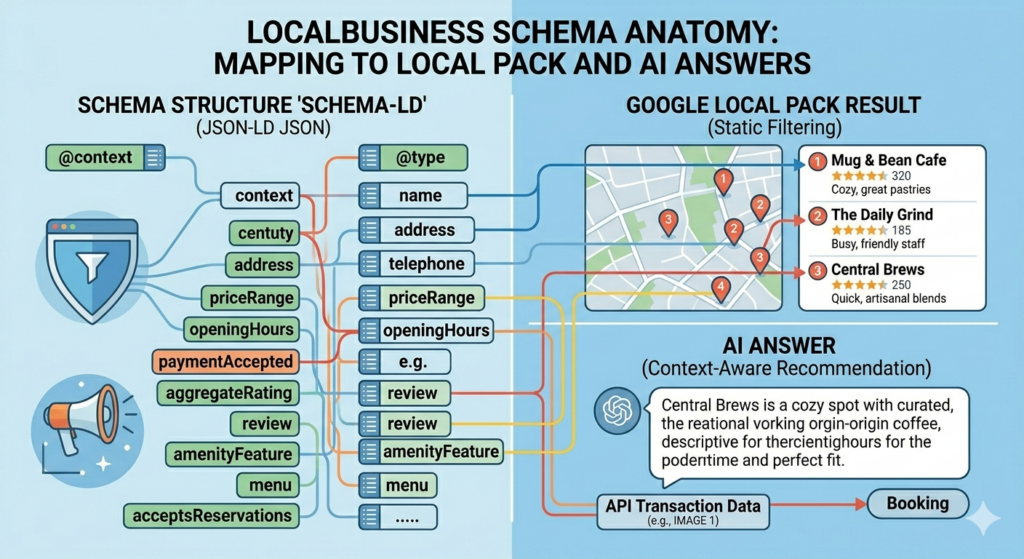
Schema markup is machine-readable code added to your website that tells search engines and AI systems exactly what your business is, where it is, what it offers, and how to contact it. For local AEO, Local Business schema is essential it is the clearest possible signal you can send directly to an AI parsing your site.
Use Schema.org’s LocalBusiness type and include: business name, address (with Postal Address), phone, opening hours, geo coordinates, price range, and service area. Validate your implementation using Google’s Rich Results Test before publishing.
- Add Review schema to display star ratings in search results.
- Use FAQ Page schema on your homepage and key service pages.
- Add Service schema for each individual service you offer.
4. Generate and Respond to Reviews Systematically
Reviews are one of the most powerful signals in local AEO. AI systems like ChatGPT are trained on review data from Google, Yelp, and Trustpilot and use review sentiment, volume, and recency to assess whether a local business deserves a recommendation. A business with 200 four-star reviews will consistently outperform a competitor with 12 five-star reviews in AI-generated local answers.
Build a simple, repeatable review request process: send a follow-up message 24–48 hours after a transaction or service completion with a direct link to your Google review page. Respond to every review positive and negative. Response rate is a trust signal that AI models factor in.
- Ask for reviews via SMS, email, or QR code at point of sale.
- Respond within 48 hours to all reviews address negatives professionally.
- Mention your services or location naturally in responses to reinforce local keyword relevance.
5. Optimise for Voice and Conversational Local Queries
Voice search is the most direct form of AEO in action. When someone asks Siri, Alexa, or Google Assistant ‘find an Italian restaurant open now near me,’ the assistant reads out a single answer. According to Statista, over 58% of consumers have used voice search to find local business information in the past year.
Voice queries are longer and more conversational than typed ones. Optimized by creating FAQ-style content on your website that mirrors how real people speak when asking about your business:
- ‘What time does [business name] open on Sundays?’
- ‘Does [business name] offer same-day appointments?’
- ‘What is the parking situation at [business name]?’
Answer each of these questions clearly and concisely on your website and GBP — one to two sentences is ideal for voice extraction.
6. Create Locally Relevant, Answer-First Content
Publishing blog posts and landing pages that answer specific local questions positions your business as a topical authority in your area and increases the chances of being cited in AI-generated local answers. This content does not need to be long it needs to be accurate, specific, and directly useful.
Examples of high-value local AEO content for small businesses:
- ‘How much does a boiler service cost in [city] in 2026?’
- ‘What are the best neighborhoods in [city] for [service]?’
- ‘[Service] checklist: what to ask before hiring a [profession] in [city].’
Use Google Search Console and Google’s People Also Ask boxes to identify exactly what local questions your potential customers are asking. Build content around those questions and lead each answer with the direct response in the first sentence.
7. Get Listed on Niche and Local Directories
Beyond Google and the major platforms, niche and hyper-local directories carry significant weight for local AEO. AI systems use these listings to cross-reference business legitimacy and categorization.The more consistently your business appears across credible local sources, the higher its entity authority.
Depending on your industry, prioritise directories like Houzz (home services), Healthgrades (medical), Avvo (legal), TripAdvisor (hospitality), and local chamber of commerce websites. Also submit to Apple Maps Connect and Bing Places for Business both feed AI assistants on Apple and Microsoft devices.
8. Use Hyperlocal Keywords Throughout Your Online Presence
Hyper local keywords terms that include specific neighborhoods, landmarks, or suburbs in addition to your city help AI systems understand the precise geographic area you serve. While ‘plumber in London’ is competitive, ’emergency plumber in Shoreditch’ is specific enough that a well-optimized small business can dominate it.
- Include your borough, district, or neighborhood on your website, GBP, and all listings.
- Create individual landing pages for each service area if you cover multiple locations.
- Reference local landmarks and well-known areas naturally in your content this reinforces geo-relevance to AI models.
Frequently Asked Questions
What is the difference between local SEO and local AEO?
Local SEO focuses on ranking in traditional search results Google Maps, the local pack, and organic listings. Local AEO goes further, optimizing your presence specifically for AI-generated answers, voice search results, and direct recommendations from tools like ChatGPT and Google’s AI Overviews. The two strategies overlap significantly but AEO requires additional focus on structured data, answer-first content, and entity authority.
How quickly can local AEO improvements show results?
Some changes — like completing your Google Business Profile or fixing NAP inconsistencies can show measurable impact within two to four weeks. Schema markup and review generation take one to three months to compound. Content-driven improvements typically take three to six months to gain traction in AI-generated results.
Is local AEO relevant for businesses without a physical location?
Yes. Service-area businesses (SABs) tradespeople, mobile services, freelancers can optimize for local AEO by defining their service area in GBP, using city-specific landing pages, and creating locally relevant content. The same principles apply; you simply optimize for the areas you serve rather than a fixed address.
Start Your Local AEO Strategy Today
Local AEO is not a replacement for traditional local SEO it is its natural evolution. Every improvement you make to your Google Business Profile, schema markup, review presence, and locally relevant content simultaneously strengthens both your traditional rankings and your AI-generated visibility.
Start with the foundations: complete your GBP, audit your NAP consistency, and implement Local Business schema. Then build outward generating reviews, publishing answer-first local content, and claiming your presence on every relevant directory. Small businesses that act now will build a local AI presence that is very hard for late movers to match.
Ready to dominate local search and AI results in your area? Explore Eximo Digital‘s Local SEO & AEO Services tailored strategies for small businesses that want to be found first, everywhere.