Search engine optimization has never been more essential or more misunderstood than it is right now. Algorithms shift, AI is rewriting how people search, and the old playbook of stuffing keywords into a blog post is not just ineffective; it can actively hurt you.
But amid all the noise, the foundations of great SEO have stayed remarkably stable. Master those, and you will be positioned to adapt to whatever Google, Bing, or the next generation of AI-powered answer engines throws at you. This guide covers every layer of modern SEO including LLM SEO, where your content needs to be readable not just by humans, but by artificial intelligence.
1. What Is SEO and Why Does It Still Matter?
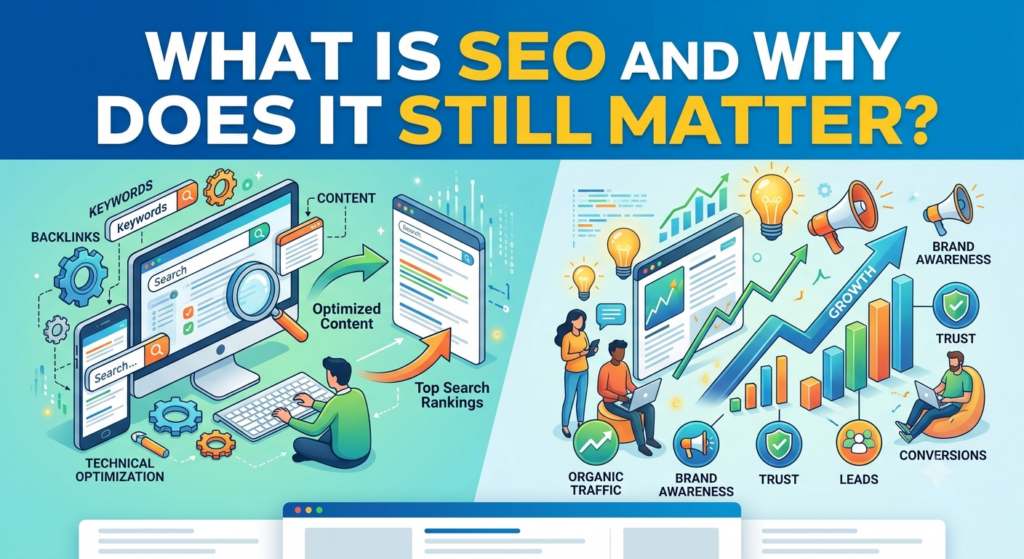
SEO (Search Engine Optimization) is the discipline of improving your website’s visibility in unpaid, organic search results. When a potential customer types a question into Google, SEO determines whether your business appears on page one or not at all.
Key statistics:
- 90% of all internet traffic comes through search engines.
- 70% of clicks go to organic results over paid ads.
- 66% of marketers rank organic growth as their top inbound priority.
- The #1 Google result gets roughly 27% of all clicks for that query.
Without SEO, your business is invisible to anyone who does not already know your URL. According to Moz’s algorithm change history, Google updates its algorithm 500–600 times per year yet the core quality signals have remained consistent for over a decade.
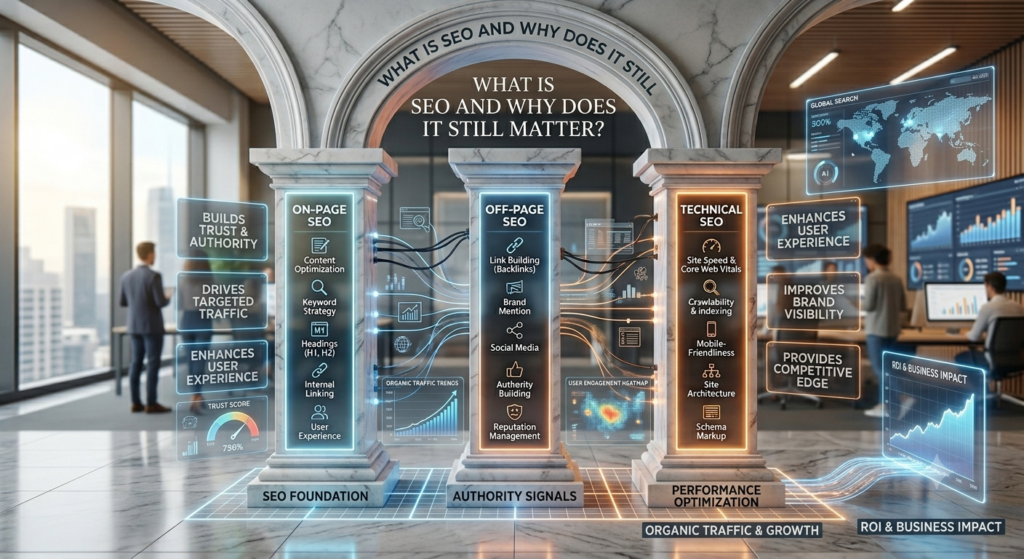
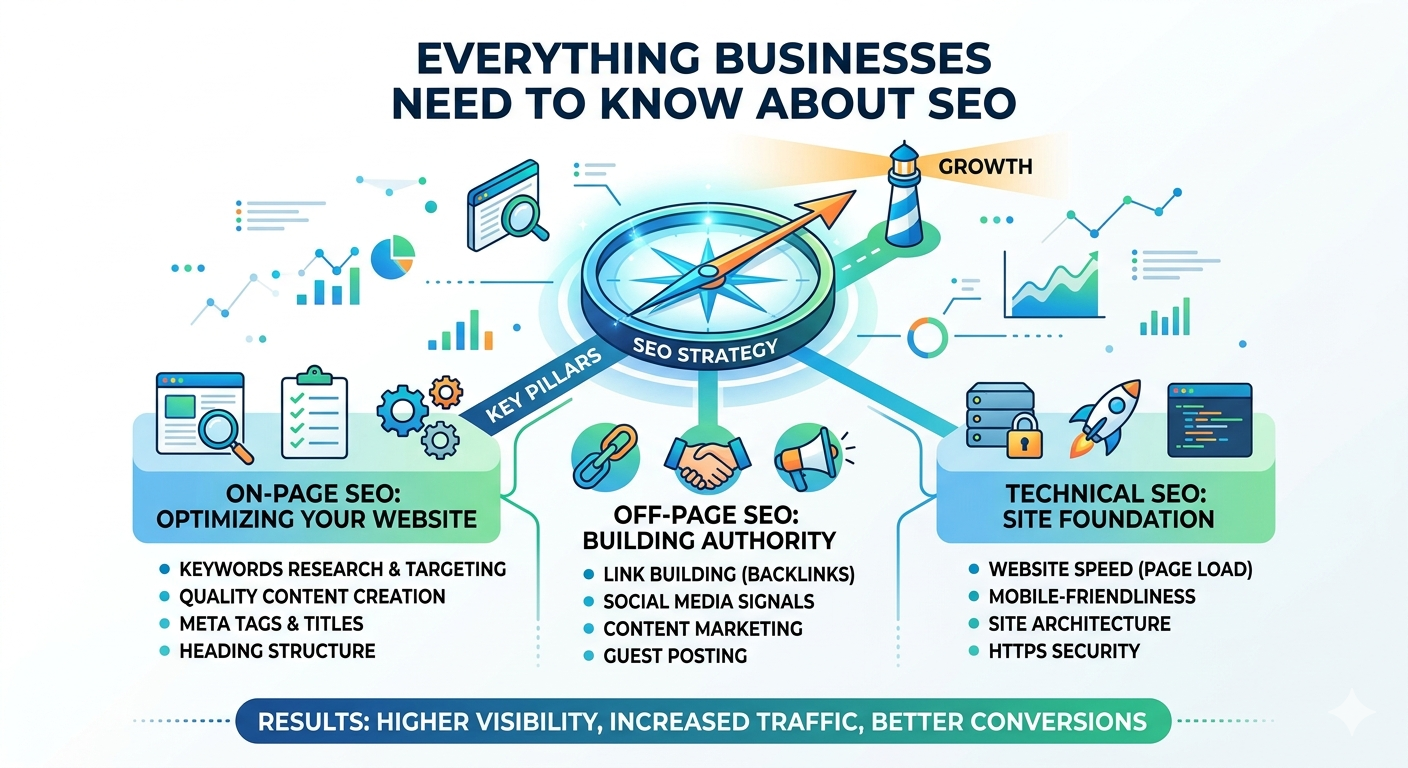
2. The Three Pillars of SEO
On-Page SEO
On-page SEO covers content quality, title tags, meta descriptions, header structure (H1–H4), URL slugs, image alt text, internal linking, and page speed. Use Google Search Console to understand your topical authority. Place your target keyword naturally in the first 100 words, in at least one H2, and in the page meta title.
Off-Page SEO & Link Building
Off-page SEO centres on backlinks links from other websites pointing to yours. Google treats each quality backlink as a vote of confidence. Quality always outweighs quantity.
White hat practices to follow:
- Guest posts on authoritative sites
- Original research and infographics
- Broken link reclamation
- Digital PR and earned media
- Skyscraper content technique
Black hat practices to avoid:
- Buying links or using link farms
- Keyword stuffing and cloaking
- Duplicate or scraped content
- Private blog networks (PBNs)
- Hidden text or doorway pages
Technical SEO
Technical SEO ensures crawlers can find, read, and index your pages. Key areas: site speed (aim for passing Core Web Vitals), mobile responsiveness, clean URL structure, XML sitemap, canonical tags, and HTTPS.
“Content and link-building are two of the most important factors Google uses to decide where it ranks your site — and quality far outweighs quantity.” — Andrey Lipattsev, former Search Quality Senior Strategist, Google
3. Keyword Research: The Foundation
Identify the exact phrases your customers search for using tools like Ahrefs, SEMrush, and Google Keyword Planner. These provide search volume, competition, and trend data for any term.
The strategic sweet spot is long-tail keywords — specific phrases like ‘best SEO agency for e-commerce in Karachi’ rather than simply ‘SEO agency.’ Long-tail terms convert better because searcher intent is clearer and competition is far lower. Pair these with broader head terms for a balanced keyword architecture.
4. Local SEO: Winning in Your Own Backyard
For any business with a physical presence or defined service area, local SEO is non-negotiable. Start with a fully optimised Google Business Profile, consistent NAP (Name, Address, Phone) data across every directory, and genuine customer reviews.
LocalBusiness schema markup tells both Google and AI assistants the precise details of your business in machine-readable format — a direct bridge into the LLM SEO world described in the next section.
5. LLM SEO: Optimising for AI Search Engines
AI-powered tools — ChatGPT, Google’s AI Overviews, Perplexity, and Microsoft Copilot — are answering user queries directly, often without users ever clicking through to a website. If your content is not structured for large language models (LLMs), you are already invisible in a fast-growing portion of the search landscape.
What Is Generative Engine Optimisation (GEO)?
GEO is the practice of structuring content so AI answer engines can understand, trust, and cite it. Unlike traditional SEO — where signals are largely technical and link-based — GEO is about clarity, authority, and retrievability. If an LLM cannot cleanly parse your answer, it will cite someone else who can.
6 LLM SEO tactics to implement now:
- 01 Answer-First Structure define the answer within the first two sentences of each section.
- 02 Schema & Structured Data implement FAQ, HowTo, Article, and LocalBusiness schema.
- 03 Topical Authority cover your subject across multiple interlinked pages.
- 04 E-E-A-T Signals author bylines, citations, credentials, and original data strengthen your AI trust profile.
- 05 Conversational Query Matching optimize for full questions, not just keyword fragments. Use FAQ sections.
- 06 Cite Your Sources content referencing reputable external data is more likely to be trusted and re-cited by LLMs.
6. Measuring What Matters: SEO Analytics
SEO without measurement is guesswork. The essential stack: Google Analytics 4 for traffic and conversions, Google Search Console for keyword performance and crawl health, and a rank tracker like Ahrefs or SEMrush to monitor positions over time.
Track organic sessions, goal completions, keyword rank movements, and domain authority over time. Review monthly, audit quarterly, and recalibrate your strategy whenever you notice significant ranking shifts.
7. Common SEO Mistakes That Kill Rankings
Misunderstanding key metrics, choosing the wrong keywords, neglecting technical health, and trying to game the algorithm are the four most common ways businesses undermine their own SEO.
But the most damaging mistake is treating SEO as a one-time project rather than a continuous discipline. Search rankings decay. Competitors publish. Algorithms update. The brands that win long-term treat SEO as an ongoing investment, not a checkbox.For an SEO strategy tailored to your business, explore Eximo Digital‘s SEO Services built around sustainable, white-hat growth that compounds over time.